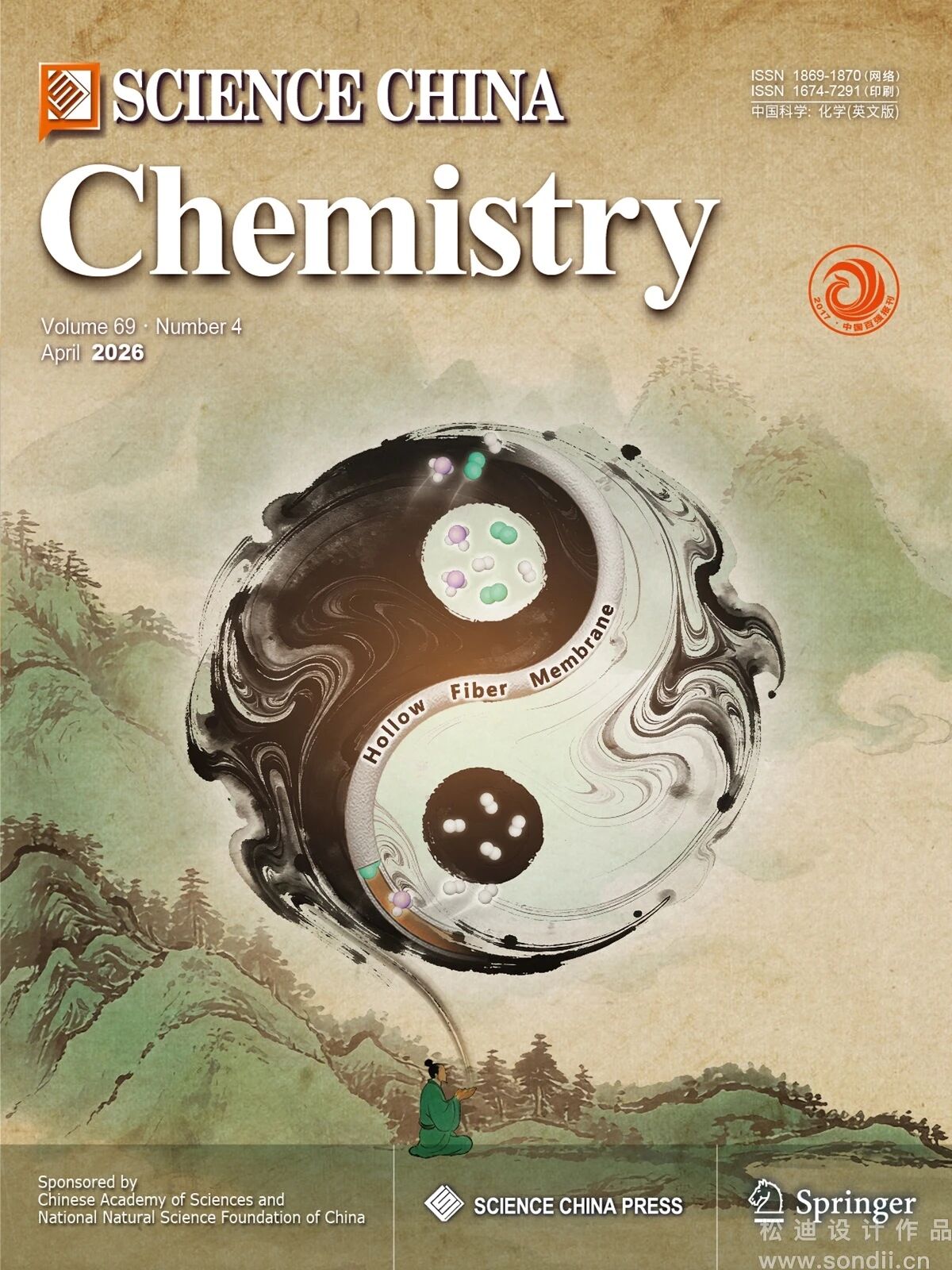
Featured Cover | SCIENCE CHINA Chemistry, Volume 69, Issue 4
How can a complex scientific concept such as hydrogen separation be transformed into a compelling journal cover?
For SCIENCE CHINA Chemistry, Volume 69, Issue 4, the answer lies in the creative integration of membrane science, molecular visualization, traditional Chinese aesthetics, and symbolic storytelling.
The cover features the review article “Hollow fiber membranes for hydrogen separation: mechanisms, fabrication, and applications”, authored by Bingbing Gao, Yameng Li, Yuhan Liu, Qi Zhang, Wei Zhang, Mengna Li, and Liangliang Dong** from Jiangnan University.
The cover was designed to translate the scientific concept of hollow fiber membranes and hydrogen separation into a visual language that is both scientifically meaningful and culturally distinctive.
Hydrogen (H₂) is widely regarded as an important energy carrier for achieving a low-carbon and sustainable energy future. As hydrogen production and utilization continue to expand, efficient hydrogen purification and separation technologies have become increasingly important.
Among various membrane-based technologies, hollow fiber membranes (HFMs) have attracted considerable attention.
Their self-supporting structure, high mechanical strength, large surface-area-to-volume ratio, and scalability make them promising candidates for hydrogen separation and purification.
However, several scientific and engineering challenges remain.
The mechanisms governing hydrogen transport through complex membrane structures require deeper theoretical understanding. At the same time, different fabrication strategies—including phase inversion, interfacial polymerization, in-situ growth, and sintering—can produce significantly different membrane structures and separation performances.
Understanding the relationship between fabrication, structure, transport behavior, and separation performance is therefore essential for moving hollow fiber membrane technology from laboratory research toward practical industrial applications.
The featured review provides a systematic overview of hollow fiber membranes for hydrogen separation.
Rather than focusing on a single material or fabrication method, the article connects different stages of membrane development into an integrated framework.
The review covers:
This creates a clear connection between:
Fabrication → Structure → Transport → Performance → Application
Such a framework is particularly valuable for researchers seeking to understand not only how hollow fiber membranes work, but also how their structures can be engineered for specific separation requirements.
The review also highlights several important directions for future research.
Future studies will need to combine molecular simulations with advanced in-situ characterization techniques to better understand how hydrogen molecules move through complex membrane architectures.
For example, the diffusion pathways through porous and dense layers, as well as the origins of molecular selectivity, remain important questions.
A deeper understanding of these mechanisms could provide a stronger theoretical foundation for rational membrane design.
Large-scale industrial application requires fabrication technologies that are not only effective but also economical, reproducible, and environmentally sustainable.
Continuous phase inversion, rapid synthesis approaches, and other scalable manufacturing strategies may provide new opportunities for hollow fiber membrane production.
At the same time, emerging materials—including metal-organic framework (MOF) composite membranes—could offer additional possibilities for improving separation performance.
Different hydrogen separation scenarios have different requirements.
Hydrogen purification from chemical by-products, for example, may require different membrane properties from hydrogen supply systems for fuel cells.
Future research could therefore establish more systematic relationships between:
Membrane structure + Operating conditions + Separation performance
Such application-oriented design could accelerate the transition of hollow fiber membranes from experimental materials to standardized industrial technologies.
For this cover, the challenge was not simply to illustrate a hollow fiber membrane.
The goal was to visually communicate the core scientific concept of selective molecular separation while also reflecting the identity of a Chinese scientific journal.
The design therefore combines modern scientific visualization with traditional Chinese visual culture.
At the center of the composition is a Taijitu-inspired form, serving as the primary visual anchor.
The concept of Yin and Yang naturally conveys ideas of balance, contrast, interaction, and separation.
These concepts can also be connected to membrane separation, where different gas molecules interact differently with the membrane and are selectively transported.
The traditional black-and-white structure therefore becomes more than a decorative cultural element.
It provides a visual metaphor for the scientific principle of selective separation.
Inside the central form, colorful molecular structures represent H₂ and other gas molecules, creating a direct connection between the traditional symbol and the microscopic world of membrane science.
In this way, the visual narrative can be summarized as:
Yin-Yang → Molecular Interaction → Membrane Selectivity → Hydrogen Separation
One of the key challenges in scientific cover design is avoiding a visual disconnect between scientific information and artistic expression.
For this cover, molecular visualization is integrated directly into the traditional composition.
The colorful molecular spheres stand out against the monochromatic Taijitu structure, symbolizing different gas molecules entering a selective membrane environment.
This creates a visual contrast between:
Traditional symbolism and modern science
Black and white and molecular color
Macro-scale landscape and micro-scale molecular structures
These contrasts help communicate the scientific concept while maintaining visual clarity.
The background incorporates elements inspired by traditional Chinese landscape painting.
Green mountains, mist, clouds, and distant scenery create a layered spatial structure while introducing a distinctly Chinese visual identity.
The mountains also provide an important metaphorical dimension.
Science begins with an exploration of nature.
At the same time, scientific discoveries can ultimately contribute to a more sustainable future.
For a study focused on hydrogen separation—a technology closely connected with clean energy and carbon neutrality—the landscape therefore reinforces the broader theme of science, nature, and sustainability.
A traditional scholar figure appears in the lower section of the composition.
Rather than functioning simply as a historical or decorative character, the silhouette represents the human role in scientific discovery.
Positioned between the foreground and distant mountains, the figure creates a sense of depth and scale.
Conceptually, it suggests that scientific progress is a continuous journey:
Observe nature → Understand its principles → Develop new technologies → Build a sustainable future
This idea echoes the research itself, which connects fundamental molecular transport mechanisms with practical membrane engineering and industrial applications.
At Sondii Scientific Illustration, we believe that complex scientific discoveries deserve equally compelling visual communication.
We specialize in scientific illustration, journal cover design, scientific visualization, book illustration, and principle animation, helping researchers transform complex concepts and research findings into clear, accurate, and visually engaging stories.
From molecular mechanisms to large-scale scientific systems, we combine scientific understanding with visual creativity to create customized artwork for researchers, laboratories, journals, and publishers.
Anhui Province Academy of Science and Technology, No. 128,Wanshui Road, Hi-Tech Zone, Hefei City, Anhui Province, China
 +86 17354022649
 service@sondii.com


 IPv6 RETE SUPPORTATA
I nostri orari
Lun 21/11 - Mer 23/11: 9:00 - 20:00
Gio 24/11: chiuso - Buon Ringraziamento!
Venerdì 25/11: 8:00 - 22:00
Sab 26/11 - Dom 27/11: 10:00 - 21:00
(tutti gli orari sono l'ora di New York)